FREE SHIPPING over $200*
Continental U.S. only.
Continental U.S. only.
Continental U.S. only.
Continental U.S. only.
You're mid-recipe and there's no cheesecloth in the kitchen. Before you make a special trip or abandon the dish entirely, several household items work as practical substitutes — some of them better than cheesecloth itself for certain tasks. The key is knowing which substitute matches the job, because reaching for the wrong one (a terry cloth dish towel, for example) can ruin what you're making.
This guide ranks all 8 common cheesecloth substitutes from best to worst, explains when to reach for each one, and tells you what to avoid. We've supplied cheesecloth and kitchen textiles to professional kitchens and home cooks since 2006 — this is the honest, practical breakdown.
| Substitute | Best For | Reusable? | Food Safe? | Rating |
|---|---|---|---|---|
| Flour Sack Towel | All tasks | Yes | Yes | ★★★★★ Best |
| Muslin Cloth | Straining, wrapping | Yes | Yes (unbleached) | ★★★★☆ Excellent |
| Nut Milk Bag | Liquid straining | Yes | Yes | ★★★★☆ Excellent |
| Coffee Filter | Small-volume straining | No | Yes | ★★★☆☆ Good |
| Medical Gauze | Straining, wrapping | No | Verify first | ★★★☆☆ Good |
| Fine Wire Sieve | Coarse straining only | Yes | Yes | ★★☆☆☆ Limited |
| Cotton Handkerchief | Soft cheese, ricotta | Yes | Yes (unscented) | ★★☆☆☆ Situational |
| Paper Towel | Emergency only | No | Yes | ★☆☆☆☆ Last Resort |
A 100% cotton flour sack towel is not just a cheesecloth substitute — in most kitchen tasks it's actually the better tool. The tight plain-weave cotton is more durable than cheesecloth, handles more washes, and works across a wider range of tasks without tearing or degrading. It's the substitute that becomes a permanent fixture once you try it.

Flour sack towels are made from the same plain-weave cotton as cheesecloth but at a higher thread count — which means more durability, better reusability, and cleaner straining for most tasks. The tight weave is lint-free, which matters when you're straining stock you'll drink or making yogurt and soft cheeses. The cotton softens with each wash and doesn't shed fibers into food.
The one scenario where cheesecloth has an edge: very open, fast straining of large liquid volumes. For most home cooking tasks, a flour sack towel handles everything cheesecloth does and holds up through far more uses. Our unbleached flour sack towels are food-safe, dye-free, and the most practical permanent replacement for cheesecloth in any kitchen.
Muslin is the most direct fabric equivalent to cheesecloth — also 100% cotton plain weave, slightly denser, washable and reusable. It's the traditional choice for culinary uses in the UK and Europe where cheesecloth is less common. Unbleached, undyed muslin is food-safe and works well for straining, bundling herbs, and wrapping soft cheeses.
Muslin softens with each wash and becomes more flexible over time. Wash before first use to remove sizing. Finding good quality muslin requires a fabric or craft store — the cheap variety from most retailers is often synthetic blend or dyed. Check the label for 100% cotton.
A nut milk bag is purpose-built for exactly the straining tasks where cheesecloth is most commonly used — almond milk, oat milk, cold brew coffee, and nut-based cheeses. The fine nylon mesh strains at least as finely as cheesecloth and is easier to squeeze and clean. If liquid straining is your primary use, a nut milk bag outperforms cheesecloth.
The drawstring closure makes squeezing out liquid more efficient than with flat cheesecloth. The main limitation is shape — a nut milk bag doesn't work for tasks that require a flat cloth (covering dough, lining a strainer, wrapping cheese). Keep both a flour sack towel and a nut milk bag if you do a range of tasks.
A coffee filter is the most widely available emergency substitute — almost every kitchen has one. It works well for small-volume straining tasks where you need very fine filtration: clarifying oils, straining small batches of stock, removing particles from infusions. Rinse the filter with water first to remove any paper taste before using with food.
Medical gauze is woven from the same cotton gauze material as cheesecloth and works as a reasonable short-term substitute. It strains effectively and can be layered for finer filtration. The important caveat: not all medical gauze is suitable for food contact. Some products are pre-treated with antiseptics or other agents — check the packaging carefully and only use sterile, plain cotton gauze with no added treatments.
A fine wire mesh sieve is not a cheesecloth substitute so much as a different tool that handles some of the same jobs. It works well for removing large particles from stocks and sauces, draining pasta cooking water, or rinsing grains. It cannot do anything cheesecloth does involving fabric — it won't hold herbs in a bundle, wrap cheese, or strain fine particles the way cloth does.
A clean, unused cotton handkerchief works as an emergency cloth for soft cheese straining — the tighter weave relative to cheesecloth actually helps with ricotta and fromage blanc by capturing more curd. Use only an unused, undyed, unscented handkerchief. Wash thoroughly before and after use. Not a practical long-term substitute given availability and hygiene requirements.
Paper towels absorb more liquid than they pass through, tear when wet under any weight, and are single-use. They're genuinely a last resort — useful only for very light, low-volume tasks like draining excess liquid from a small amount of yogurt or soft cheese. Place inside a strainer, don't try to hold it by hand, and pour very slowly. For anything more demanding, reach for one of the options above.
A flour sack towel is the best overall substitute — 100% cotton, food-safe, reusable, and more durable than most cheesecloth. It works for straining, wrapping, covering dough, and herb bundles. A nut milk bag is the best substitute specifically for straining liquids like almond milk or cold brew. For a true emergency, a coffee filter works for small-volume tasks. Avoid terry cloth, microfiber, or any synthetic fabric.
Only if it's a 100% cotton flour sack towel — thin, lint-free, and undyed. A standard terry cloth dish towel absolutely does not work — it sheds fibers into food and the thick loop weave doesn't strain effectively. Never use a dish towel with fabric softener residue or any synthetic content as a cheesecloth substitute.
Yes — unbleached, undyed 100% cotton muslin works well. It's slightly denser than cheesecloth which means finer filtration but slower straining. Wash before first use. Muslin is the traditional substitute in kitchens where cheesecloth isn't available. The main thing to watch: bleached or dyed muslin can leave residue in food — always use natural unbleached.
Yes, for small-volume tasks. Rinse the filter first to remove paper taste, place inside a strainer, and pour slowly — coffee filters tear easily under weight or fast-moving liquid. Works for clarifying oils, small stock batches, and infusions. Not suitable for pressing cheese or large volumes. Single-use only.
Last resort only. Paper towels absorb more liquid than they pass through, tear easily when wet, and can only handle very light draining tasks. Place inside a strainer and pour very slowly. For anything more demanding, use a flour sack towel, coffee filter, or nut milk bag instead.
Never use terry cloth dish towels (shed fibers into food), microfiber cloths (shed synthetic fibers), dyed fabrics (dye transfers into warm liquid), any fabric with fabric softener residue, or synthetic/polyester fabrics. These will contaminate your food or fail to strain effectively.


These are the blank 27″×27″ flour sack towels that gift brands, DTG and screen printing studios, personalization businesses, and e...
View full details
DTG (Direct-to-Fabric) printing delivers unlimited colors and smooth gradients — ink that bonds directly into the cotton fiber, with no crac...
View full details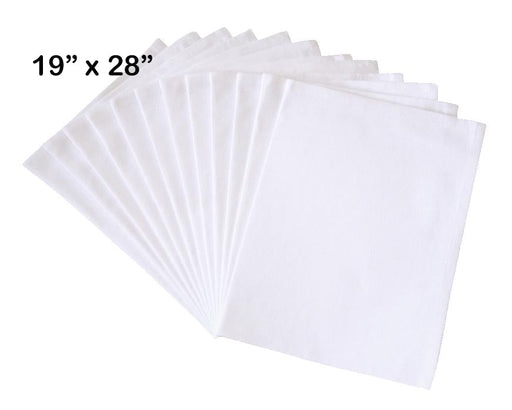
The 19″×28″ rectangle is the classic tea towel format — the size embroidery studios, gift brands, and personalization businesses r...
View full details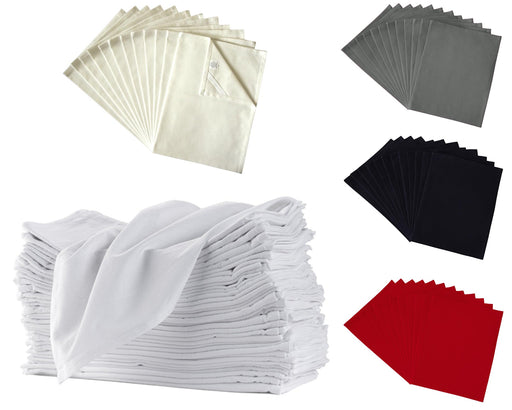
The same heavyweight 130 thread count, 100% cotton flour sack fabric as our white and natural towels — now in six colors: blue, gr...
View full details
Screen printing is the best choice when your design uses solid colors, bold shapes, or clean line art — and you're producing 24 or ...
View full details


